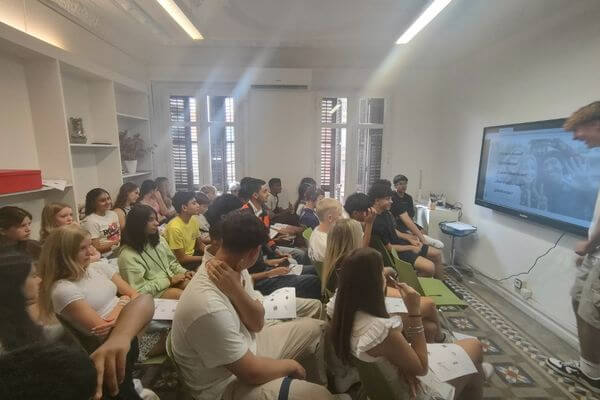
Hi, I’m Olivia! I’m an intern at Languages4Life originally from California who recently had the chance to help our School Director Maria teach a class of 60 students visiting from England. Here are a couple of my intern insights!
60 students is a lot

At our school, we normally teach small group or one-on-one lessons, so this was an experience I had never seen before. It also meant we got to teach in one of the classrooms of a university less than five minutes away from us, which was super cool! It felt weird for us to be teaching in a traditional classroom, with rows of desks, but for this many people it was necessary.
It was an intimidating idea at first that it was only going to be Maria and I with this class. The teachers the students arrived with get to drop them off with us and they relax, explore, and do whatever they want while we are teaching. And unlike Maria, I have never handled a class this large before! Thankfully, the students were very nice and respectful, so while a class of 60 can get rowdy, this class was a breeze.
Fun learning games
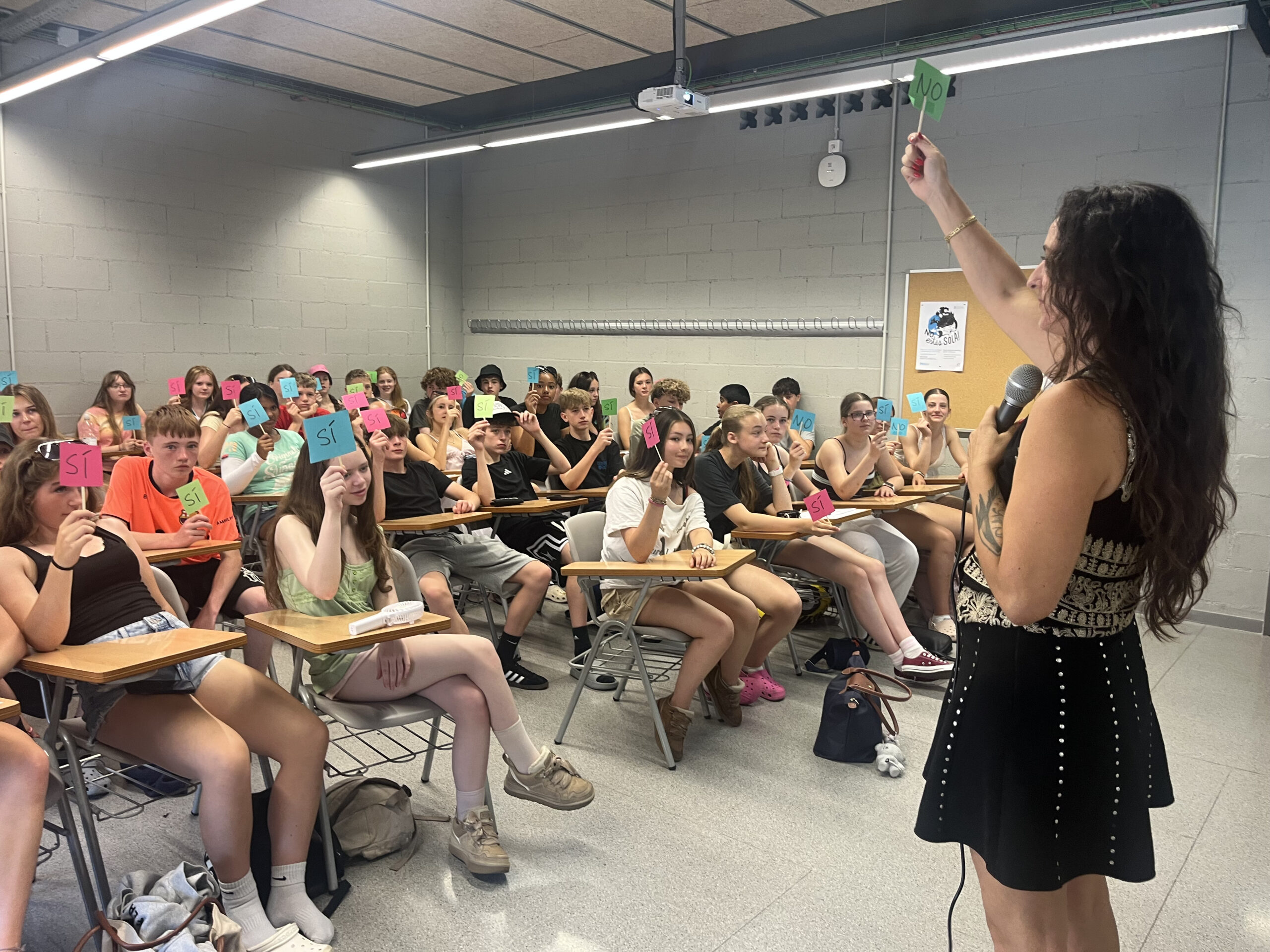
Despite being in a traditional classroom, the lesson plan was far from it. Unlike what I was used to from my high school Spanish classes, there weren’t any grammar charts or lists of vocabulary words to memorize. Instead, there were games like “¿Sí o No?” that asked questions in Spanish they would answer with handheld paddle signs and “Guess Who?” that described people in Spanish for the students to guess. That meant that students would contextually learn new vocabulary and then in later activities, when they got to pick someone to describe for their own “Guess Who?”, they knew how to describe them in Spanish.
These games were chosen very thoughtfully for the size of the classroom because every student could participate with their paddle signs without the classroom getting too loud, and there were other games that had students split into smaller groups too. What I enjoyed the most, as an intern behind the scenes, was figuring out what topics were engaging to British youth. Maria and I would discuss, sometimes bringing some of our teachers into the conversation, things like “do you think they know who this celebrity is?” and “do teenagers still like Roblox?” (spoiler alert, they really do). It was a fun challenge that paid off in making the activities engaging and relevant to the students.
Conclusion: I was impressed!
Languages4Life has consistently shown me how learning can be fun, and you really can learn with a gamified methodology without the use of typical textbooks. I was impressed by how much the students had learned in what felt like such a short amount of time just by playing games. I have no doubt that the way that we create engaging language learning will help these students, and all our students, retain the knowledge we have shared with them in the classroom.